Decay & pre-delay
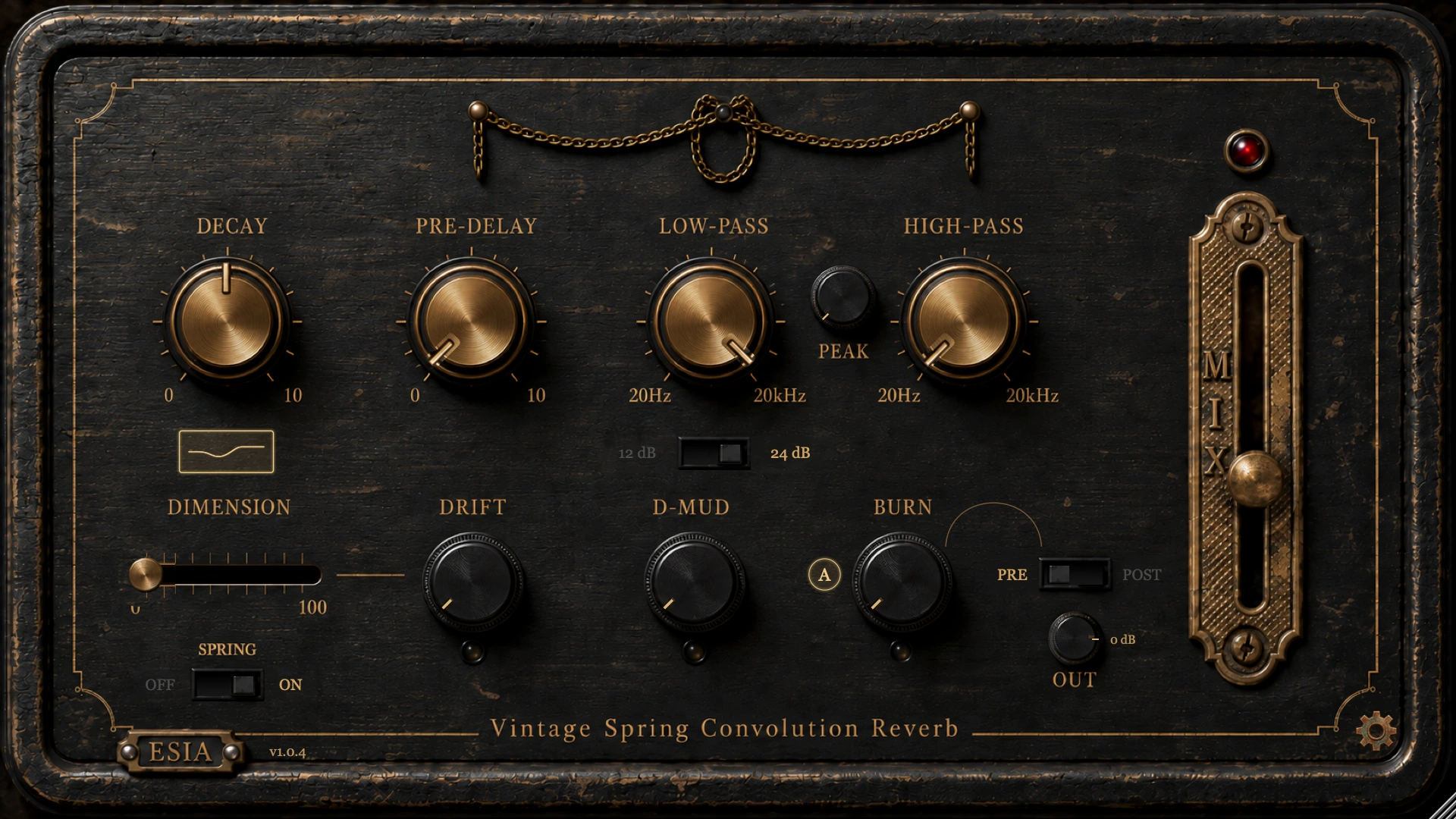
Set the length and arrival of the spring, then place it in the mix.

Vintage Spring Convolution Reverb
Already have access? Install the plugin. For purchase questions, see our refund policy or contact support.
The story behind ESIA
ESIA began with a real vintage spring reverb I own and love. Its spring was captured from the physical unit and modeled through convolution, bringing that unmistakable response into a modern session with the freedom I always wished the hardware could offer.
The other modules grew from that wish: ways to shape its tone, push its edges, and let it move. Each grew out of a sound I wanted to reach in my own work. Together, they make ESIA a personal instrument for character, space and discovery.
Inside the instrument
Set the length and arrival of the spring, then place it in the mix.
Shape the tone with low-pass and high-pass filtering. Choose a 12 or 24 dB per octave slope for the low-pass.
Give the sound width and a subtle motion beyond a static spring response.
D-Mud attenuates the low mids, reshaping the weight of the sound as it clears buildup. Burn adds valve-inspired saturation and distortion.
Beyond reverb
Give a dry instrument weight, let a melodic line drift across the stereo field, or push a spring tail into a darker, driven texture. Switch the spring off and keep the tone, distortion and movement: ESIA remains a creative part of your chain, even without a reverb tail.
Try ESIA




Play a sample of your choice and hear how ESIA shapes it:
Vintage Spring Convolution Reverb
A spring with a story, and room to take it somewhere new.